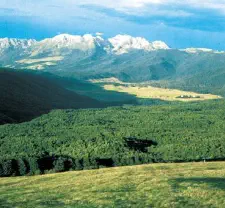
Cansiglio and Gruppo del Cavallo from the summit of Pizzoc (G. Bettolo)
Cansiglio, a plateau in the Carnic Pre-Alps straddling the provinces of Belluno, Treviso, and Pordenone, overlooks the Veneto-Friuli plain with its southern and eastern slopes, while to the north it is bordered by the Alpago region and to the northeast by the Cavallo mountain range. Finally, to the west, the Val Lapisina separates it from Col Visentin. With its characteristic basin shape, its central part consists of three depressions: Pian Cansiglio, Valmenera, and Cornesega, where the lowest altitude (898 m) is reached. The surrounding hills are around 1300 m high, except to the west and south-west, where Mount Millifret (1577 m) and Mount Pizzoc (1565 m) are located. to the east, Mount Croseraz reaches 1694 m. The main valley routes, which provide access to the basin, are those of Campon (1050 m) to the north and Crosetta (1118 m) to the south. The climate is temperate and cold with cool summers. The cold air that descends from the inner slopes stagnates in the basin, giving rise to the characteristic phenomenon of thermal inversion: the temperature decreases as it moves from the surrounding hills to the lower central areas. The temperature extremes range, albeit in exceptional conditions, between +30° and -30° C. Although the average annual rainfall is around 1800 mm, there are no permanent watercourses due to the karstic nature of the territory. Atmospheric humidity is high almost all year round, and the valley is often filled with thick fog, which forms due to the significant daily temperature variation.
Geology
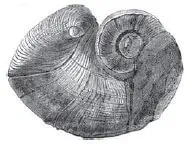
Caprina distefanoi
The rocks of Cansiglio are mainly sedimentary: of marine origin, they were formed during the Cretaceous period by the accumulation of organic remains of marine animals and plants (corals, madrepores, mollusks, algae). After the rocky layers emerged from the sea and the central area of the plateau subsided, it was exposed to atmospheric agents, giving rise to the phenomenon of karstification, which currently characterizes the entire landscape and underground environment. Rainwater has an erosive and corrosive effect on limestone rocks, especially if they are cracked, and promotes the formation of more or less extensive basins. Sometimes small depressions in the ground typical of the karst environment, known as sinkholes, become clogged with debris and clayey material, making them impermeable and causing permanent water stagnation, locally known as ‘lame’. For centuries, these small pools of water were the only sources of water available to both humans and animals, as karstification prevents the development of surface waterways: all the water seeps underground and resurfaces at the foot of the plateau, where it feeds numerous springs.
The underground karst formations are mainly vertical, such as sinkholes: the best known and most studied of these are the Bus della Genziana, 587 m deep, and the Bus de la Lum, 185 m deep, remembered for the sad events of World War II. These places, still partly unexplored, have not only been the subject of scientific and literary writings (since the last century), but also of popular legends that have added to their aura of mystery.
The flora
Beech tree in winter attire (S. Vicenzi)
Visitors arriving in Cansiglio for the first time are struck by the beauty of its forest, strongly characterized by the presence of beech trees (Fagus sylvatica), often very tall and with columnar trunks. Under the canopy, in the undergrowth, shade-tolerant species grow: ferns, wood anemones (Anemone nemorosa), green hellebores (Helleborus viridis), and wood sorrel (Oxalis acetosella). The beech forest varies in beautiful colors with the changing seasons and, like all the vegetation in the basin, is affected by temperature inversion: as a result, it is mainly found on the hills surrounding the plain, where the climate is milder. As the altitude decreases, the beech is associated with silver fir (Abies alba) and Norway spruce (Picea excelsa), forming a mixed forest that in March is pervaded by the intense scent of mezereon (Daphne mezereum), a small shrub with brightly colored flowers. Further down, near the central depressions, there are pure spruce forests, mostly of artificial origin, where the undergrowth vegetation is poorer.
Finally, at the bottom of the basin, where it is colder, there is an area of natural grassland vegetation that humans have profoundly altered over time for livestock farming purposes, not only expanding it at the expense of the forest, but also carrying out a rigorous selection of plant species. These wide open spaces are dotted with the varied colors of seasonal blooms: the spring blooms of gentians (Gentiana verna, Gentiana Clusii) and crocuses (Crocus albiflorus) are particularly striking.
The flora of Cansiglio (both inside and outside the basin), together with that of the Cavallo-Col Nudo mountain range, has attracted the keen interest of botanists since the first half of the 18th century. During the ice ages, the Cansiglio-Cavallo group remained free of thick ice cover, providing refuge for flora and favoring the survival of endemic species such as the silver geranium (Geranium argenteum). Of particular interest are the wetlands (lakes, peat bogs), which are protected by law due to their fragility and scientific importance.
Wildlife
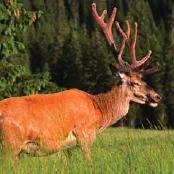
Deer (M. Stroppa)
The Cansiglio, an area where hunting has been banned for some time, provides refuge for many animal species. The mammals most easily spotted, especially at dusk, are roe deer (Capreolus capreolus) and red deer (Cervus elaphus), which are present in large numbers in the forest. These herbivores, together with fallow deer (Dama dama), introduced in the past by humans, are constantly expanding due to the lack of natural predators, although in recent years the presence of lynx (Felis lynx) and occasional incursions into the forest by brown bears (Ursus arctos) have been reported. Many mustelids also live here, animals with crepuscular and nocturnal habits, such as the marten and the stone marten (Martes martes, M. foina), the badger (Meles meles) and the weasel (Mustela nivalis), the smallest carnivore in the whole country.
The only representative of the canidae family is the fox (Vulpes vulpes): a mammal with very versatile eating habits, it can be encountered returning from its nightly hunt to its den, often hidden near sinkholes and small swallow holes; among the leporids, on the other hand, it is possible to see the common hare and occasionally the mountain hare (Lepus europaeus, L. timidus). Among the rodents, the agile squirrel (Sciurus vulgaris), the dormouse (Glis glis), and numerous voles and wild mice are common, while among the insectivores we find the hedgehog (Erinaceus europaeus), the mole (Talpa europaea), and the lesser-known shrews. Many of these small mammals provide abundant food for diurnal and nocturnal birds of prey: among the former, the most common are the buzzard, kestrel, goshawk, and sparrowhawk, while golden eagles (Aquila chrysaetos) are only occasionally seen. among the nocturnal birds we find the tawny owl, the pygmy owl, the Tengmalm’s owl and the sporadic eagle owl.
Golden eagle (F. Mezzavilla)
The capercaillie (Tetrao urugallus), present alongside other tetraonids (hazel grouse, ptarmigan, black grouse), is now a rarity. More common, but equally interesting, among the corvids are the crow, often seen near houses, and the colorful jay. In spring, the typical song of the cuckoo, a parasitic bird, is easily recognizable even from a distance. Walking along the edges of meadows and pastures, the lark, a small passerine bird, can be recognized as it hovers noisily over its territory. In the woods, signs of digging left on tree trunks reveal the presence of black woodpeckers and great spotted woodpeckers, regular visitors to the forest. In spring and autumn, during migration, it is not uncommon to spot water birds such as storks and mallards, especially near the blades, which temporarily enrich the karst environment of the plateau in an unusual way.
Amphibians find favorable environmental conditions in the damp glades and ravines of the forest, so it is not difficult to come across specimens of newts (Triturus alpestris, T. cristatus), toads, and frogs. Reptiles include the common adder (Vipera berus), the asp viper (Vipera aspis), the grass snake (Natrix natrix), as well as some lizards such as the viviparous lizard (Lacerta viviparis) and the slow worm (Anguis fragilis), which find abundant food in the abundance of invertebrates.
Prehistory
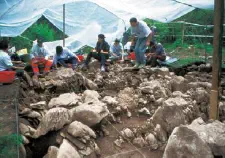
Archaeological excavations (M. Peresani)
Archaeological and paleoenvironmental research conducted by the University of Ferrara in Cansiglio since 1993 has found indisputable evidence of prehistoric human presence dating back perhaps as far as 100,000 years ago. However, more complete data concerns a more recent phase of prehistory, thanks to the greater number of archaeological sites and their better state of preservation. These settlements shed light on the relationship between Cansiglio and the groups of hunter-gatherers who, starting 12,000 years ago, systematically frequented the plateau to exploit the food resources offered by the forests that grew after the last Quaternary glaciation. In fact, Upper Paleolithic man established his first camps (tents probably made of wood and skins) near Bus de la Lum: tools commonly used for subsistence activities (scrapers, retouched blades, and chisels for working leather, wood, horn, and bone) have been found here.
Of particular interest is the site of Palughetto, near a wetland area, where man created a reserve of flint stones to be chipped as needed. On the western side of Pian Cansiglio, dozens of Mesolithic camps dating back between 10,000 and 8,000 years ago have been identified thanks to the presence of numerous stone artifacts: it is likely that some of these camps were home to men dedicated exclusively to the preparation of weapons for hunting. This set of discoveries suggests that during the Upper Paleolithic and Mesolithic periods, groups of hunter-gatherers adopted a semi-nomadic lifestyle: during the winter season, they settled in Alpago or in the Veneto-Friuli plain, while between late spring and early autumn they lived in the mountains.
History
Drawing taken from a badge of the San Marco Forest Guards from 1793 (V. de Savorgnani)
The first written record mentioning Bosco d’Alpago (as the Cansiglio forest was then called) is a diploma dated 923 issued by Berengar I, crowned King of Italy with the support of the ecclesiastical authorities, in which the sovereign donated the forest to the fiefdom of the Bishop-Count of Belluno. In the following centuries, numerous grazing rights were granted to institutions and private individuals, but the pressure of human activities on the forest intensified when, during the communal era, Cansiglio became the property of the Community of Belluno. The fate of the forest only improved in the early 15th century, when the Belluno area also sought protection from the Republic of Venice.
The Venetians were aware of the importance of controlling forests and waters for the survival of the fragile balance of the lagoon and therefore of their own city. For this reason, in the early decades of the 16th century, they established a magistrate “over woods and forests” to preserve the forests of the mainland. The Cansiglio also had enormous economic importance for the Venetian state: its rich beech forest was used mainly for the production of oars, timber, and charcoal. The French and Austrian governments, which succeeded the Serenissima with varying degrees of success, implemented careless management, offering opportunities for revenge on the forest heritage to the neighboring populations until, after the birth of the Kingdom of Italy in 1871, the Italian government declared Cansiglio an inalienable state forest. The most recent history of the plateau is marked by the tragic events of World War II: Cansiglio became the headquarters of volunteers from nearby areas who, with varying degrees of success, joined the partisan struggle.
Museum of Man in Cansiglio
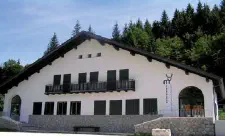
Museum of Man in Cansiglio “A. Vieceli”
The MUC – Anna Vieceli Regional Museum of Man in Cansiglio – Center for Ethnography and Cimbrian Culture is located in Pian Osteria. In the 1970s, with the help of the Cimbrian community in Cansiglio, the State Forestry Corps began collecting documents, artifacts, and work tools; the museum was inaugurated in 1975. With the gradual transfer of forest ownership from the state to the regions, in 1997 the museum was transferred to the Veneto region, which entrusted its management to Veneto Agricoltura. In 2004, renovation work began on the building, with a new and complete redesign of the interior space and adaptation to current museum standards in terms of safety, accessibility, and usability. The museum now occupies two floors, and the new layout presents a complete overview of human presence in Cansiglio from prehistory to the present day, with finds from the Paleolithic period to the present day. The Roman period and the Middle Ages are still little known, while the 250 years of domination of the forest by the Serenissima Republic of San Marco are well documented and supported by numerous archival documents. Some rooms are dedicated to the presence of the Cimbrian community on the plateau and to forestry activities from the 19th century to the present day.
The Zanardo Ecological Museum
Founded in the second half of the 1960s thanks to the initiative of the then Forest Inspector G. Zanardo, this small but comprehensive museum, managed by the State Forestry Corps, houses naturalistic exhibits relating to the plateau. In the central hall, visitors can observe animals typical of beech and spruce forests and meadows in artificially reconstructed environments, among which a male deer stands out for its beauty. One section of the exhibition is entirely dedicated to the plateau’s numerous birdlife: in addition to specimens of birds of prey, nocturnal and diurnal birds, corvids, and picids, the pairs of black grouse and capercaillie among the tetraonids are of great interest. Of particular importance are the collections of invertebrates and reptiles that inhabit the Cansiglio-Cavallo area, gathered in another small room. Equally noteworthy is the section devoted to geological and geomorphological history, which includes fossils and illustrative panels describing the past processes that gave rise to Cansiglio and the karst phenomena that characterize the current landscape.
The Botanical Garden
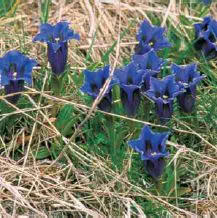
Gentiana kochiana (V. de Savorgnani)
The Alpine Botanical Garden, conceived in 1972 by Prof. G. G. Lorenzoni of the University of Padua and Forest Inspector G. Zanardo, has been expanded in recent years under the management of the former Veneto Regional Forestry Agency, now Veneto Agricoltura. This site is home to around 500 species of plants found in the Cansiglio-Cavallo area, organized in part by environment: in a small space of about one and a half hectares, it brings together vegetation from forests, shrublands, meadows and pastures, macerets and snow valleys, cliffs, and other types of vegetation. Of great interest are the wetlands: the lake and the two peat bogs, which are also home to numerous species of amphibians and insects. During a visit to the Garden, even the least experienced visitor can observe the characteristics of individual species and understand the complexity of the surrounding landscape. In addition, a small collection is dedicated to medicinal species, i.e., plants used in the preparation of medicines.
The educational purpose is accompanied by scientific and conservation goals: here it is possible to study the many aspects of flora in complex ecological relationships and, at the same time, cultivate and reproduce the species most threatened with extinction. The Garden’s activities are supported by the technical and scientific collaboration of the Botanical Garden of the University of Padua and, since 1993, by the contribution of the voluntary association “Friends of the Cansiglio Alpine Botanical Garden.”
The charcoal kilns
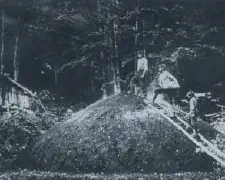
Charcoal burners (Collezione G. Pignata)
The production of sweet charcoal in Cansiglio has been documented since the Middle Ages. Under Venetian rule, this activity became so widespread that it had to be regulated: it was an important resource for the Arsenale and at the same time ensured the cleanliness of the forest, using waste from forestry work and low-value plants. Once the lot to be charred had been obtained, the charcoal burners set up a small shelter, which was useful during their stay in the forest. They then cut the wood and prepared the clearing, called aiàl, where the charcoal kiln, the poiàt, was to be built. They arranged the wood in concentric layers around a central chimney. The diameter and height of the charcoal kiln varied according to the availability of raw materials. Once completed, the pile was covered with leaves or twigs and soil. Embers and small pieces of wood were then introduced through the central chimney and had to be continuously renewed because the carbonization, or cooking, process depended on the heat produced by their combustion. Through a series of holes in the covering, the amount of air entering was carefully controlled, even at night, while allowing the smoke from combustion to escape. At the end of the process, after allowing the poiàt to cool, the product was collected and bagged.
Peat bogs
Peat bogs, common in northern Europe, are quite rare in Italy, where they are mainly concentrated in the Alps and, exceptionally, in the Apennines. Their formation is due to a combination of specific climatic factors that are uncommon in Italy, such as a constant supply of cold water, relatively low temperatures, and high rainfall. In these environmental conditions, organic debris from animals and plants, which are protected from decomposition processes, create layers of peat that can be several meters deep. These wetlands, although small in size, are home to plants that are generally not very showy but of great naturalistic value, such as the round-leaved sundew (Drosera rotundifolia), a relict glacial species that, to compensate for the scarcity of nitrogen compounds, has specialized in capturing small insects, or sphagnum mosses, which create soft carpets characterized by tall clusters capable of storing large quantities of water even in the upper part of the mounds.
Peat bogs also play a key role in the study of glacial and post-glacial events on the plateau: their ability to preserve organic matter unchanged for very long periods of time allows us to reconstruct the evolution of the vegetation and landscape of the surrounding area by analyzing the peat and the pollen grains it contains. Due to their exceptional environmental characteristics, peat bogs, whose existence was once threatened by land reclamation and industrial use of peat, are now protected by law.
The Cimbri
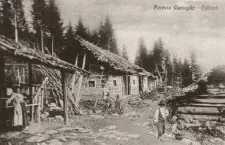
The Cimbri in Vallorch (Collezione G. Pignata)
The historical origins of the Cimbri (from the Cimbrian word “tzimbar,” meaning woodworker) date back to groups of German-speaking settlers who, around 1100-1300, left an area between Tyrol and Bavaria to settle in Italy, where some feudal lords needed skilled workers in forestry. The Cimbri arrived in Cansiglio as seasonal woodcutters, probably leaving in the 18th century from Roana, one of the seven municipalities of the Asiago Plateau, where there is still a strong community that speaks the Cimbrian language. Later, during the 1800s, they built villages, some of which still exist (Le Rotte, Vallorch, I Pich, Canaie, Campon, Pian Osteria), to which they also moved their families and where there are still some typical casoni, wooden structures resting on stone foundations and covered with fir shingles. The rich beech forest of Cansiglio provided them with work as woodcutters and craftsmen, supplying abundant timber for the production of scatoi, slats of varying length and thickness used to make sieves, cheese molds, and other household items, which were highly prized in towns outside the forest.
Currently, some descendants of the Cimbri still live in Cansiglio, but most of them, following the socio-economic changes after World War II, settled in the surrounding villages (Spert, Tambre, Fregona), where some still practice forest-related activities or have emigrated.
The Cimbri of Cansiglio are recognized as an ethnic minority in the Veneto Region and are represented by the Cimbri del Cansiglio Cultural Association based in Pian Osteria, which carries out historical research and promotes and disseminates the Cimbrian language, traditions, and culture, including through publications. In this context, it is worth visiting the Museum of Cansiglio and the Cimbri in Pian Osteria, the museum area of the ancient village of Pian Canaie Vecio, the ‘Huta’, a typical work hut located outside the Pian di Ladro-Baldassarre Reserve, and the villages scattered throughout the forest. On the first Sunday in August, the village of Pian Osteria celebrates the feast of St. Oswald, patron saint of the Cimbri, with a re-enactment of their ancient crafts.
Texts by Letizia De Martin and Vittorio de Savorgnani, courtesy of: